Urgent
Severe pain
Pain that persists can signal active inflammation of the nerve: it is better not to wait.

Endodontics by Dubois
Root canal treatment, carried out under the operating microscope at the Hôpital Kirchberg (HRS) and in Luxembourg-Merl. A clinical report is sent to your regular dentist as a matter of course.
What is endodontics?
Endodontics treats the dental pulp, that is, the living tissue inside the tooth, made up of nerves and blood vessels. When it becomes infected or is irreversibly damaged by deep tooth decay, a crack or an injury, root canal treatment often makes it possible to keep the natural tooth rather than extract it.
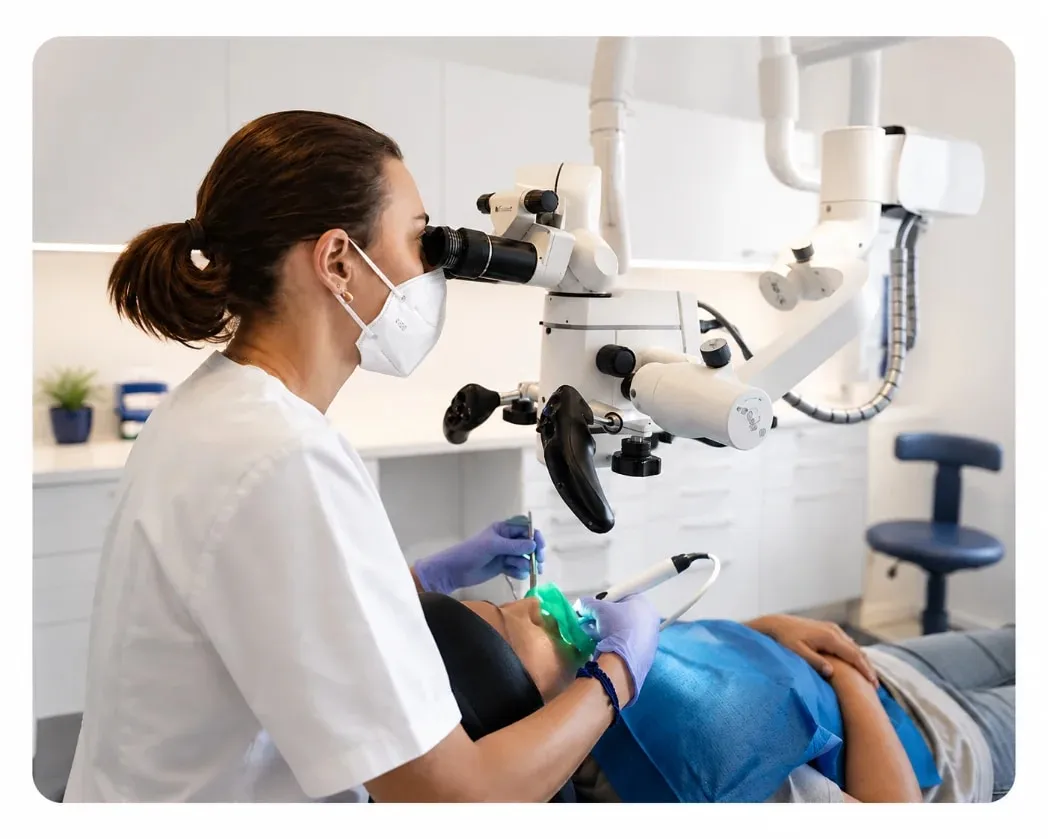
The principle is always the same: disinfect the inside of the roots, shape them, then seal them tightly to prevent any bacteria from returning. What differs from one case to the next is the anatomy: the number of canals, their curvature, their calcification. That is why we work under the operating microscope: magnification reveals fine canals that would remain invisible to the naked eye.
Do you recognise any of these signs? Here is why it is worth being seen, and how soon.
Pain that persists can signal active inflammation of the nerve: it is better not to wait.
Left untreated, deep decay can reach the nerve and call for more extensive treatment.
A knock, even without immediate pain, can weaken the tooth over the long term.
A tooth already treated that becomes sensitive again may need endodontic retreatment.
Swelling or a pocket of pus signals an active infection to be treated quickly.
When conventional retreatment is not enough, a targeted procedure at the root can save the tooth.
The treatment
Endodontic treatment takes one or two appointments, depending on the anatomy of the tooth and the state of the infection. Here are the five steps, from diagnosis to the definitive restoration.
Clinical examination, sensitivity tests and X-ray. A Cone Beam 3D scan is taken when the anatomy of the canals or the extent of the periapical lesion cannot be judged from a two-dimensional image.
Local anaesthetic, then rubber dam isolation to keep the tooth away from saliva. This isolation determines the result: it stops oral bacteria from recontaminating the canals during treatment.
Under the operating microscope, the canals are disinfected and then shaped along their whole length. The magnification makes it possible to find fine or calcified canals that would remain invisible to the naked eye.
The canals are sealed to prevent any bacterial recolonisation. A temporary filling closes the tooth until the definitive restoration is placed.
Your general dentist places the definitive filling or crown. An X-ray check-up may then be offered to confirm the bone healing around the root.
Afterwards
Treatment is often carried out on bone that is already inflamed or infected: some sensitivity in the days that follow is normal. Here is what to expect, and what should prompt you to contact us again.
Sensitivity when chewing is a normal, temporary reaction: the treatment often involves bone that is already inflamed. A painkiller or an anti-inflammatory will relieve it, to be taken if there is pain and not as a matter of routine.
Eating with a numb lip or cheek risks bites you cannot feel. Wait until the effect has worn down, then chew on the opposite side for the first few days.
A gum or a cheek that swells in the days that follow must be assessed: an antibiotic is sometimes needed. Contact us rather than waiting for it to pass.
Tell us about any known allergy and any medication you are already taking. If in doubt, ask your doctor before taking any medicine for a dental problem.
It does not stay sealed over time. Left too long, or too thin, it lets saliva recontaminate the inside of the tooth. A temporary crown that has come loose must be re-cemented without delay.
An X-ray check-up may be offered to you to confirm that the bone has rebuilt around the root. Endodontic treatment remains a treatment that carries risk: in some cases, the survival of the tooth cannot be guaranteed.
A question, unusual pain, a doubt about a medicine? Call the Luxembourg-Merl clinic on (+352) 26 68 11 30 0. We will do our utmost to see you again quickly.
It is the treatment that disinfects the inside of the root or roots of a tooth whose pulp (the living tissue at its centre) is infected or irreparably damaged. The practitioner cleans the canals, shapes them, then seals them. The aim is to keep the natural tooth rather than extract it. We carry out these treatments under an operating microscope, at the Hôpital Kirchberg (HRS) and in Luxembourg-Merl.
The procedure is carried out under local anaesthetic and is not painful. It often involves bone around the tooth that is already inflamed or infected, however, which explains the sensitivity when chewing in the days that follow. That reaction is normal and temporary. It is relieved with a painkiller or an anti-inflammatory, to be taken if there is pain and not as a matter of routine.
Contact us. Swelling of the gum or the cheek in the days after treatment must be assessed: it may warrant a prescription for an antibiotic. Do also tell us about any known allergy and any medication you are currently taking. If you are in any doubt about a medicine, ask your doctor before taking it for a dental problem.
Because it does not stay sealed over time. A temporary filling that is too thin, or left in place too long, lets saliva and the bacteria it carries recontaminate the inside of the tooth: the result of the treatment is then compromised. The definitive filling is placed by your general dentist. If a temporary crown comes loose, have it re-cemented without delay.
No, and it is important to know that before starting: endodontic treatment is a treatment that carries risk. In some cases, despite everything that is done, the survival of the tooth cannot be guaranteed. That is why an X-ray check-up may be offered to you after treatment, to confirm the bone healing, that is, the disappearance of the “black patch” visible on the X-ray.
Wait until the effect of the anaesthetic has worn down or gone, so as to avoid biting your lip or cheek without feeling it. Once the feeling has returned, favour the opposite side for the first few days and avoid chewing hard on the treated tooth until your general dentist has placed its definitive filling.
Looking for something else? The full FAQ also covers reimbursement, emergencies and practical arrangements.
Endodontics is available at two of our clinics, the only ones equipped with the operating microscope and Cone Beam imaging: the Hôpital Kirchberg (HRS), where our clinic is located, and Luxembourg-Merl. Treatment there is provided by three practitioners working in endodontics only.
Refer your patients to us using our short form. A clinical report every time.
Referring dentists →